How to Soundproof a Room is a common question these days, as many people are seeking quietness and a calm daily routine without experiencing the unwanted noise entering or even leaving the room, and noises from the other nearby homes or offices.
But we must mention at first that soundproofing is different from sound absorption, which mainly controls echo inside a room, but soundproofing reduces the sounds coming from outside, such as traffic, neighbors, or construction.
Or even the internal noise that can come from appliances, footsteps, or music in apartments that have these walls. There are different solutions to improve comfort, privacy, and focus. The soundproofing is useful for music rooms, gaming setups, offices, and bedrooms.
Soundproof room material can be installed by yourself using some of the mentioned solutions in this blog. As there are both professional and DIY methods to reduce noise and different materials for walls, floors, ceilings, and doors
In this blog, you will know how to soundproof a room cheaply, outside and inside, to reduce the sound for music and gaming.
What Does Soundproofing Really Mean?
Soundproofing is a process to reduce or eliminate or block the sound from entering, such as traffic, neighbors, construction, and street activity, or leaving the room, such as music rooms, gaming setups, and home studios, and that is done by adding smart solutions to walls, floors, ceilings, doors, and windows to improve privacy and comfort.
You must know that there is no complete silence to achieve in residential buildings, because it requires different materials and techniques. Most homes provide sound reduction, not full sound elimination.
So when we aim to soundproof a room, we focus on doors, windows, and ceilings because they are often the weakest points for sound leakage. Also, they are another solution and professionals using structural changes; also, their DIY methods focus on surface treatments.
Soundproofing requires sealing all air gaps because sound travels easily through small openings, and using heavier and thicker materials to block sound, and that is what we will learn next in this blog.
The differences between Soundproofing and Sound absorption
Soundproofing blocks sound from entering or leaving the room, focusing on sound isolation using dense and heavy materials like extra drywall, while sound absorption controls echo and reverberation inside the room, improving sound quality within the space using soft materials such as acoustic panels.
The Soundproofing solution works by stopping sound transmission through walls, floors, ceilings, doors, and windows. While the sound absorption works by reducing sound reflections from hard surfaces.
When to choose between Soundproofing and Sound absorption? Choose soundproofing if you are living with daily outside noise like traffic, neighbors, or construction. But choose the sound absorption solution if you have a music room, podcasts, gaming, or a home theater, and you don’t want to make noise for neighbors or improve the sound quality.
In a soundproofing solution, sealing air gaps is required; compared to sound absorption, this step is not essential. As the soundproofing usually involves structural or construction changes, the sound absorption is often surface-level and decorative, such as acoustic wall panels.
Soundproofing is generally more expensive and complex than sound absorption, but sound absorption has a feature that soundproofing misses, which is that it can be DIY-friendly and quick to install.
Best Materials for Soundproofing a Room
If you’re wondering how to soundproof a room for gaming, adding acoustic panels and rugs can help reduce noise from escaping or entering. Let’s discover sound proof room material from the following:
Mass-Loaded Vinyl (MLV)
Mass-Loaded Vinyl is a dense, flexible, and heavy soundproofing material designed to block airborne noise like traffic and bass without major structural changes in walls, floors, and ceilings, without taking up much space. It can be installed behind drywall or under decorative wall panels. The MLV is often used in home studios, apartments, and offices.
Double Drywall with Green Glue
The Double Drywall with Green Glue is a high-performance soundproofing solution that applies green glue, a viscoelastic damping compound, between two layers of drywall that converts sound vibrations into heat, which reduces the noise transfer.
This material is ideal to use if you have shared walls in apartments or townhouses, and it works best when combined with insulation inside the wall cavity.
Mineral Wool Insulation
Mineral Wool Insulation is a high-performance fibrous material that absorbs and blocks sound inside wall cavities, is made by spinning molten minerals, and performs better than standard fiberglass for acoustic control.
It features fire resistance, superior soundproofing capabilities, moisture resistance, and thermal efficiency. It is ideal to use in walls, ceilings, and floors in new builds or renovations and is commonly used in home studios, offices, and bedrooms.
Acoustic Sealant
Acoustic sealant is a flexible acrylic-based caulk used to seal small gaps and cracks, which are considered sound leak points in walls, floors, and ceilings. It is applied also to door frames, windows, electrical outlets, and drywall joints.
It features a flexible material over time, unlike the regular sealant, which hardens and cracks. The acoustic sealant is easy to apply and DIY-friendly, as it is a low-cost solution.
Acoustic panels
Acoustic panels are sound-absorbing materials designed to absorb sound waves and reduce echo and reverberation inside a room to improve the sound clarity for music rooms, home offices, gaming setups, and studios.
It doesn’t completely block sound on its own, but it enhances overall soundproofing performance when it’s combined with other materials. They are installed in walls and ceilings.
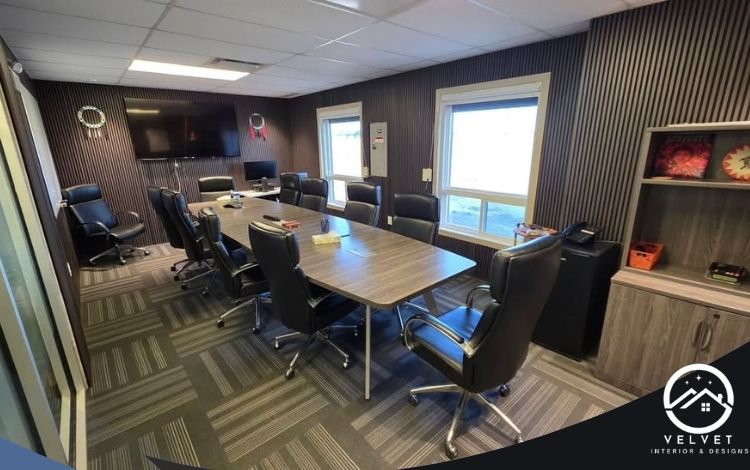
Acoustic panels are available in various designs and materials like fabric, polyester, wood slats, and WPC acoustic panels; they are easy to install and DIY-friendly due to their lightweight material.
How to soundproof a room from outside
To soundproof a room from outside, you can seal gaps and cracks with acoustic caulk or install weatherstripping around doors and windows, which works perfectly with Canadian weather. There is another option, which is to replace the hollow doors with solid-core doors or add door sweeps to block sound at the bottom.
A different solution is to use heavy curtains and rugs to reduce sound reflection or apply soundproofing foam to key areas. You can even add bookshelves or furniture against the walls to absorb noise.
There is a common question, which is how to soundproof a room for music; these solutions also work to soundproof a room for music and gaming or any noisy activities.
How Velvet Interiors Enhance Soundproofing
Velvet Interior and Design offers 3 products that enhance your room soundproofing with a durable material and at an effective cost, starting with the acoustic wood wall panel, which are designed to absorb sound and reduce echo and reverberation, making the room comfier and quieter.
The second product is WPC Fluted Panels made from durable wood-plastic composite, which helps to reduce sound reflection. The groove design in the panel works as a sound diffuser, ideal for living rooms, TV walls, offices, and commercial spaces.
The third choice of Velvet store to enhance soundproofing is using the Wood Veneer Panels installed with an acoustic felt backing, which helps to improve acoustics by reducing sound reflections and softening echo while adding a natural, warm wood appearance. Perfect for feature walls in offices, bedrooms, meeting rooms, and media areas.
By following these tips, you’ll know how to soundproof a room in an apartment, how to soundproof a room from inside, and even how to soundproof a room with thin walls or for gaming purposes.
FAQ about How to Soundproof a Room
How can you cheaply soundproof a room?
You can cheaply soundproof a room by using thick curtains or blackout drapes to block outside noise for living rooms or offices. Another solution for the noise from the floor is to lay down rugs or carpet. For doors, use door sweeps or weather stripping to seal the gaps.
Can you 100% soundproof a room?
No, it is difficult to 100% soundproof a room; most methods and solutions reduce noise rather than fully block it. As the soundproofing requires controlling walls, floors, ceilings, doors, and windows. As well as to external vibrations, like traffic or construction.
How to soundproof a room that is already built?
You can soundproof a room that is already built by sealing cracks and gaps in walls, windows, and doors with acoustic caulk. Or to add door sweeps to block sound leaks. Or placing rugs, carpets, or underlays on the floor to reduce impact noise.
How to drown out noisy roommates?
To drown out noisy roommates, you can use the white noise machines, play soft background music, add thick rugs or curtains, or install acoustic panels on shared walls to reduce sound transmission; the acoustic panels are available in different designs and colors in Velvet Interior Design at an effective cost and with easy installation.